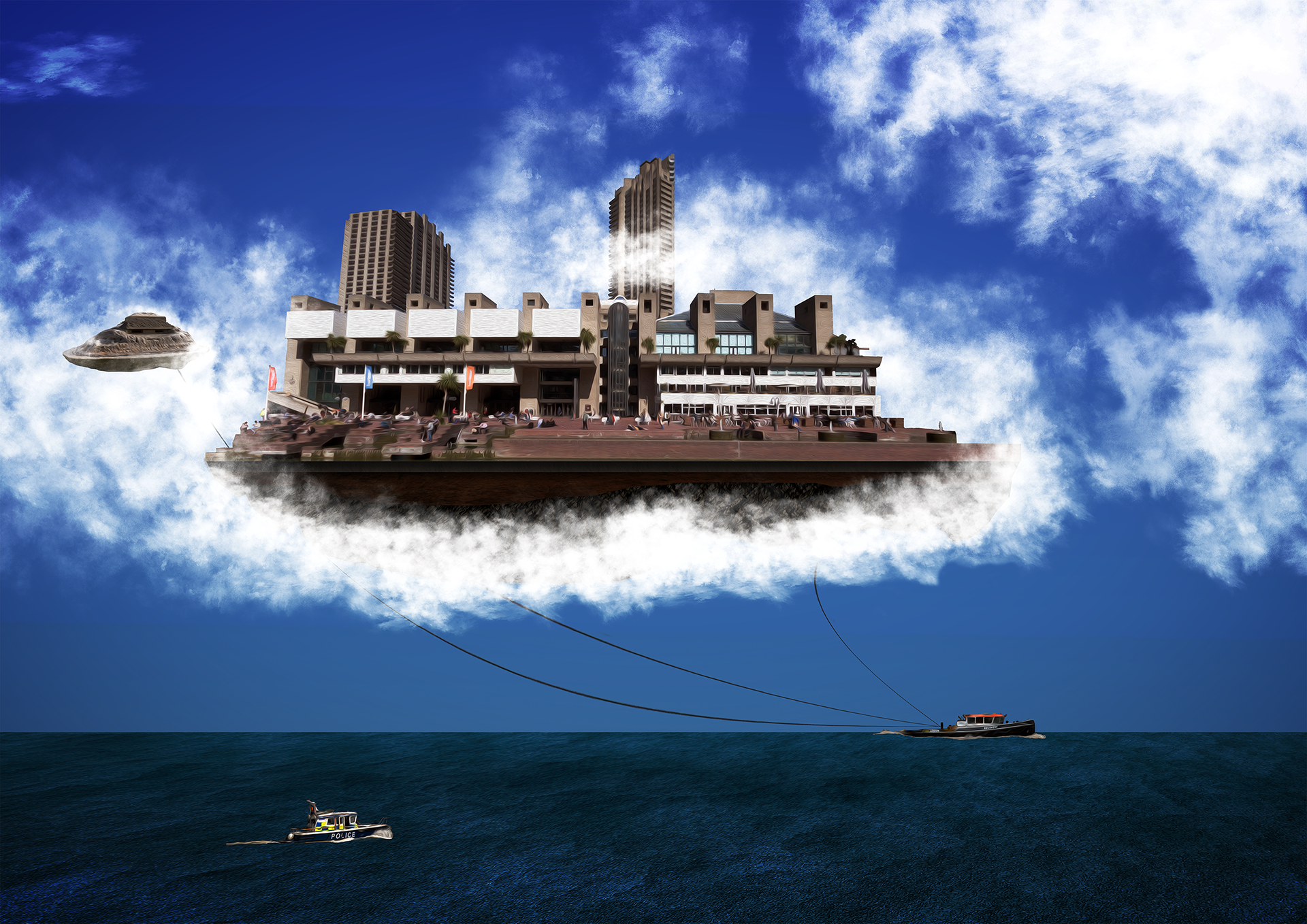
Lost is a photographic series that explores the fragile and often contradictory relationship between Brutalist architecture, the notion of Utopia, and the legacy of twentieth-century bunker architecture. The project centres on the Barbican Centre in London — a site that has become both a personal fixation and a recurring subject within my practice — and uses it as a lens through which to examine how utopian ideals are conceived, constructed, and ultimately eroded over time.
Designed and built by Chamberlin, Powell and Bon in the post-war period, the Barbican was envisioned as a radical urban experiment: a self-contained community situated within the heart of the city, offering safety, culture, and social cohesion amid the physical and psychological scars left by the Second World War. In many ways, this vision echoes earlier philosophical definitions of Utopia, most notably Thomas More’s 1516 text, which describes an idealised society free from conflict, scarcity, and suffering. Lost positions the Barbican within this historical lineage, questioning whether such ideals can ever truly be realised — or whether they are destined to become distorted, forgotten, or “lost” as time progresses.
A key conceptual foundation of this project lies in the relationship between Brutalism and bunker architecture. Brutalism’s defining characteristics — raw concrete, monumental form, and an emphasis on function — share a clear material and ideological lineage with the military bunkers constructed during the 1930s and 1940s. Concrete, chosen for its affordability, durability, and defensive capabilities, became both a literal and symbolic material of protection during wartime. This connection is explored extensively by theorists such as Paul Virilio, whose writings examine how architecture shaped by conflict becomes inseparable from ideas of surveillance, control, and security. In Lost, I draw upon Virilio’s theories to frame the Barbican as a paradoxical space: one that simultaneously embodies protection and isolation, refuge and exclusion.
While the Barbican was never a bunker in the literal sense, its elevated walkways, inward-facing design, and fortress-like presence suggest a psychological continuation of wartime architecture. These qualities complicate its utopian promise. What was once imagined as a sanctuary within the city can, from a contemporary perspective, feel detached, imposing, or even dystopian. Lost engages directly with this tension, asking whether the Barbican has shifted from a symbol of post-war optimism into a monument of unrealised ideals.
Rather than documenting the site in a conventional architectural manner, this project focuses on absence, dislocation, and reconstruction. The images within Lost are meticulously composed digital composites, created through an extensive post-photographic process in which the act of making extends far beyond the moment the shutter is pressed. Each final image is built from dozens of individual layers — skies, water, clouds, architectural fragments, and rendered elements — all carefully assembled to form a cohesive yet surreal environment. This approach reflects my long-standing interest in photography as a process rather than a fixed record of reality.
The central image of the series depicts the Barbican as a floating structure, emerging from clouds above an expansive body of water. This visual displacement removes the site from its geographical context and repositions it as a kind of unreachable utopia — suspended between reality and imagination. The intervention of clouds and open space introduces a dreamlike aesthetic, reinforcing the sense that this is a place that can be seen but not accessed. In this way, the Barbican becomes a metaphor for utopian ideals themselves: visible, alluring, yet perpetually out of reach.
Smaller narrative details within the image are deliberately left ambiguous. A police boat, for example, can be interpreted in multiple ways — as a force preventing access to the utopia, as a form of surveillance, or as an escort protecting what remains of it. Similarly, the inclusion of bunker-like structures alludes to themes of defence and containment, subtly reinforcing the architectural lineage between Brutalism and wartime construction. These elements are not intended to dictate a singular reading but instead invite viewers to construct their own interpretations, allowing the work to function as an open-ended visual narrative.
Influence from contemporary photographic and digital artists such as Hiroshi Sugimoto, Jim Kazanjian, Erik Johansson, and Riccardo Bagnoli is evident throughout the series. Like their work, Lost exists in a space between reality and fiction, using carefully constructed imagery to challenge the viewer’s perception of place, time, and architectural meaning. These references have informed not only the visual language of the project but also its conceptual ambition: to create images that reward slow looking and critical reflection.
Lost also represents a significant technical and professional development within my practice. Throughout the project, I expanded my skills in advanced compositing, digital rendering, and video production, producing both still images and promotional materials that draw upon my background in graphic design and illustration. The marketing and staged release of the series — including teaser content and a formal launch aligned with the degree exhibition — were conceived as extensions of the work itself, reinforcing its themes of anticipation, distance, and desire.
Ultimately, Lost is an exploration of what happens when utopian ideals collide with lived reality. It reflects on how architectural visions rooted in hope can become monuments to absence, and how spaces designed for community can, over time, feel disconnected from the societies they were meant to serve. By reimagining the Barbican as a floating, fragmented, and contested space, this project seeks to question not only the fate of a single architectural site, but the broader viability of utopia itself in the modern world.